
Article 21 of Directive (EU) 2022/2555, transposed in Romania by OUG nr. 155/2024, expects essential and important entities to handle vulnerabilities and to know what they are protecting. In practice every assessment reaches the same bottleneck: the asset inventory. Not whether one exists — most organisations have something — but whether it describes reality on the day you are asked.
Inventories are built once, by hand, and then diverge quietly. A component gets upgraded during an incident at 02:00 and nobody updates the sheet. A supplier re-platforms a service. A server that was decommissioned on paper is still answering. The document stays neat while the estate moves.
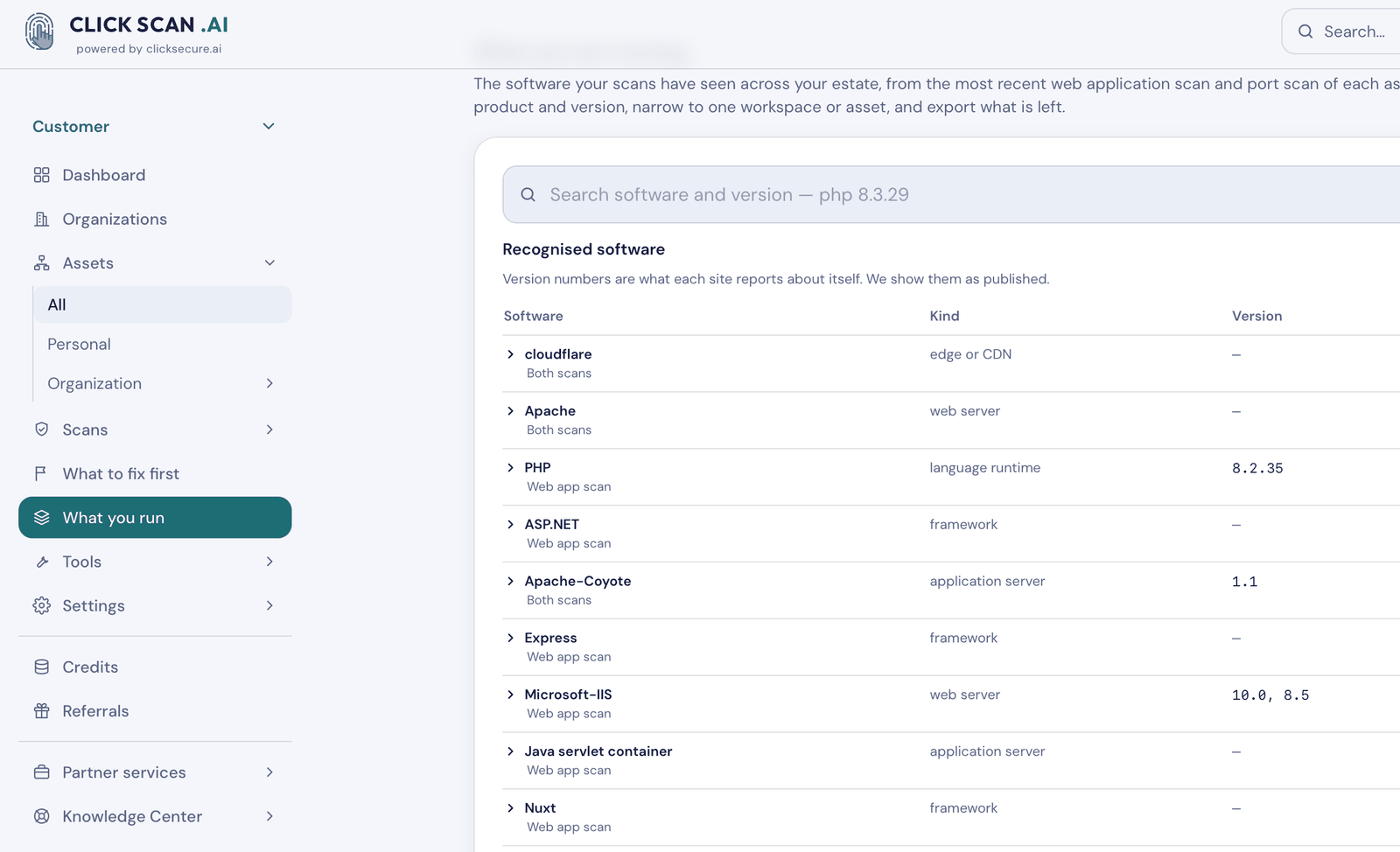
ClickScan now produces a second record that does not depend on anyone remembering to maintain it. What you run lists the software its scans have seen across your assets — product, kind and version — built from the most recent web application scan and port scan of each one. You can search by product and version, narrow to a single workspace or asset, and export the result.
What this is good for
Answering an advisory in minutes rather than days. When a CVE lands in a component you might be running, the organisational cost is rarely the patch. It is the two days spent establishing whether you are exposed at all, during which nothing is remediated. Searching the product name and reading back the versions and the assets they sit on collapses that step — and it produces an export you can hand to whoever owns the remediation.
A cross-check against the official inventory. The interesting output is the difference between the two documents. Software your scans found that the inventory does not list is either shadow IT or a stale record, and both are findings worth having before an auditor finds them for you. This is a routine worth scheduling, not a one-off.
Evidence with a date on it. A spreadsheet asserts. A dated, exported scan result observed from outside your perimeter is a different class of artefact — it says what was actually reachable and what it reported about itself, on a given day. In an evidence pack it sits alongside the configuration documents rather than replacing them.
Where it stops, stated plainly
The page itself carries the caveat, and it belongs in any use you make of the data: version numbers are what each site reports about itself, shown as published.
That limit is real and we have written about it repeatedly, because it keeps deciding incidents. Distributions backport security fixes without changing the version string, so a package from Debian, Ubuntu or RHEL can read as vulnerable while already being fixed. Alpine's patched OpenSSH packages kept their old upstream numbers after the SSHole flaw this month. A GitLab instance on a fixed release can still be loading a vulnerable Ruby inside its own container image.
So the honest framing for a self-assessment is this: an external software inventory is strong evidence of what your estate exposes and declares, and it narrows the population that needs investigating from hundreds of hosts to a handful. It is not a determination that a given host is or is not vulnerable. Closing that gap means checking the build, which is a vulnerability assessment question, and establishing whether an exposure is actually reachable and chainable is a penetration testing question.
There is also the reading that matters most to a risk owner. Everything on that page was derived from what your servers tell anyone who asks. Somebody scanning your address ranges assembles the same table without an account and without your permission. The feature does not create that exposure; it just stops you being the last party to see it.
Looking at it
Both of these are open with no account:
- What ClickScan checks — every check that runs today, by family and asset type.
- Sample reports — real output, so you can judge the format before pointing anything at your own estate.
Sign-up at app.clickscan.ai is passwordless and needs no card, and new accounts receive starter credits. Where the question is which obligations apply to you in the first place, the NIS 2 and DORA checklist is the better starting point, and an audit and compliance review is where an inventory becomes part of a defensible evidence set.
This article is general information, not legal or regulatory advice.